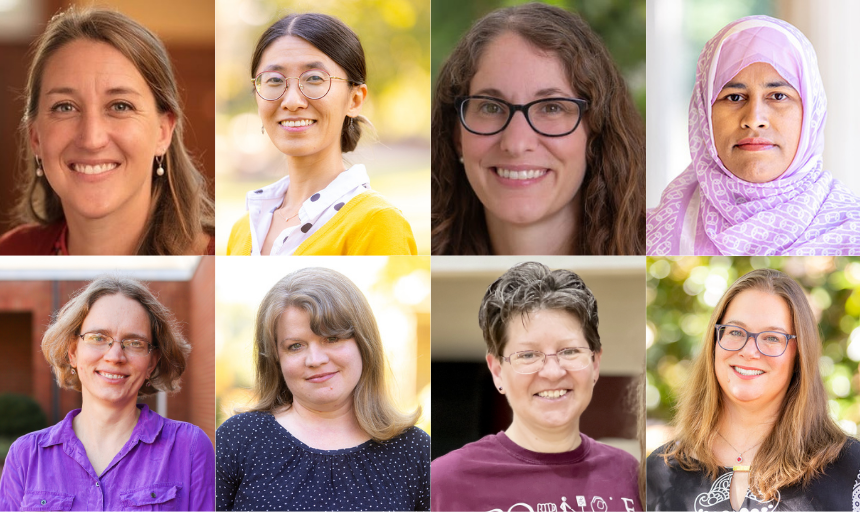
Exciting things are happening across campus as faculty and staff share their expertise in journals, conferences, and the media. Check out a few highlights:
Professor Liz Ackley (Health and Exercise Science) authored a magazine article for The Roanoker examining the strong, community-led wellness efforts at work in Virginia’s Blue Ridge — projects she’s worked closely with as director of Roanoke College’s Center for Community Health Innovation. Drawing on her extensive experience in the field, Ackley outlined a practical blueprint for successful initiatives built on neighborhood input, local data, and strategic community partnerships.
Assistant Professor Wen Bu (Psychology) published a paper, “Perceived institutional mindset is associated with college students’ psychological experiences and academic outcomes,” in the Journal of Social Psychology. Her research examined how students’ perceptions of their college’s mindset impacts their sense of belonging, confidence, well-being, and academic success.
Lecturer Beth Easterling (Criminal Justice) co-edited an award-winning book, “Incarceration and Older Women: Giving Back, Not Giving Up” by Dr. Regina White Benedict. The book received the Division of Feminist Criminology Award from the American Society of Criminology, which recognizes outstanding achievements by sociologists and activists in their fields. It was published posthumously after Benedict’s death in 2021. Easterling, a close colleague and friend, worked with co-editor Dr. Lois Presser to preserve Benedict’s work and share the stories she recorded of women aging in prison, focusing on how they found meaning and purpose in life while incarcerated.
Assistant Professor Dr. Fatima (Physics) presented at a meeting of the American Association of Physics Teachers (AAPT) in Washington, D.C. Her presentation, “Integrating Nanoscience into the Classroom: An Introductory Course on Nanomaterials,” explored ways to weave nanoscience into undergraduate education. Fatima highlighted innovative concepts and hands-on experiences that can help prepare students for the evolving world of research in nanoscience and technology.
Lecturer Teresa Hancock-Parmer (Spanish) published new research in the journal Hispanófila and Women’s History Today. Her work explores the role of early modern Hispanic women in biblical writing. Their devotional and theological works, including a 17th-century Song of Songs commentary by Mariana de San José, show these women to be important producers of spiritual knowledge. Hancock-Parmer also presented her scholarship on Sor Hipólita de Rocabertí, whose work wasn’t recognized until after her death, at the Sixteenth Century Society Conference held in Portland.
Director of International Student Services Sarah Lupton (Student Success) was quoted in U.S. News & World Report sharing advice for international students heading to college in the United States. Lupton emphasized that students aren’t alone as they navigate these big transitions. Colleges like Roanoke offer a robust network of faculty, staff, and community support to help new students feel more connected and confident. She encouraged international students to dive into the opportunities ahead, ask questions, and practice their English without agonizing over mistakes.
Lecturer Frances McCutcheon (Disability Studies) was featured on WFXR for her analysis of Mattel’s first-ever autistic Barbie doll, a major milestone for inclusion in children’s toys. McCutcheon has long championed efforts to expand representation and access in recreation, partnering with her students to create two innovative outreach programs: Toy Like Me at Roanoke College and MAPLES (Multiple Adaptive Play Experiences in Sports).
Professor DB Poli (Cannabis Studies) was interviewed by Forbes to shed light on the difference between hemp seed oil and CBD oil. She dispelled common myths about hemp, using her expertise to help educate a national audience on an important but frequently misunderstood topic.