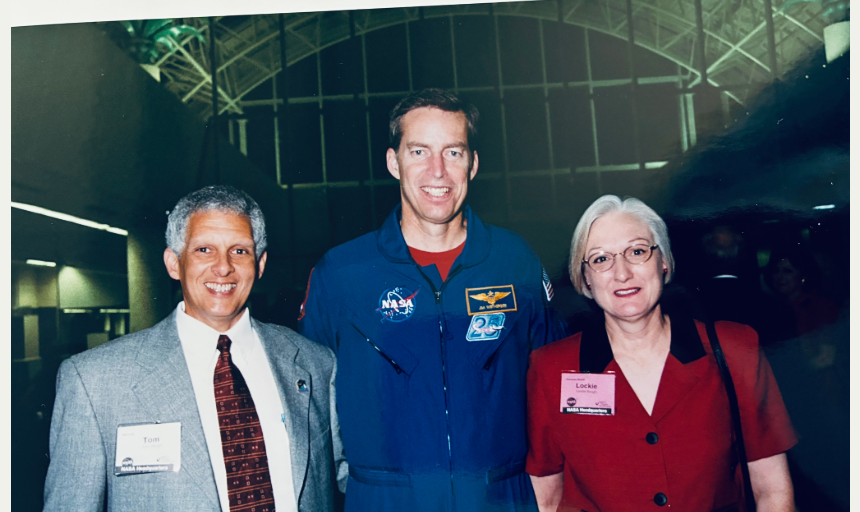
As a child in Chesterfield County, Va., years before Neil Armstrong walked on the moon, Tom Baugh ’73 was captivated by the far-off galaxies of science fiction.
“It was that idea of what could be possible,” said Baugh, a political science graduate. “I would try to imagine if there was more out there than I knew. The ‘what if’ interested me.”
Baugh — who earned a law degree from Washington and Lee and a master’s in urban studies from Trinity University — couldn’t have known he’d build a career at NASA, visiting space centers nationwide and negotiating procurement contracts.
His path to the Johnson Space Center, hub of the manned space flight program, wasn’t straightforward. But it was shaped by that embrace of the unknown.
And it started for him at Roanoke College. Just 16 after high school, Baugh moved and joined the recently desegregated campus, becoming one of only a few Black male students living on campus and one of the first who wasn’t an athlete.
“People wondered sometimes why I went there,” he said with a chuckle. “But the answer was simple. I went there to get an education and got a good one at that.”
Growing up in the rural South, where even desegregated schools were still socially divided, Baugh described Roanoke as being “thrown into the deep end of integration.”
“Roanoke was the first time I really found myself with individuals who weren't African American,” he said. “I roomed with Douglas Vaught ’73 from Galax, Va., and we became good friends. He just accepted me for who I was, as did many other individuals at Roanoke. Those friendships were instrumental.”
Originally, Baugh planned to follow his father into medicine but was miserable in his lab courses. It was the social sciences — government, history, geography — where he thrived. Political science professor Bill Hill connected him with an internship in the General Assembly, where he got to see future governor Doug Wilder in action. That kindled an interest in public administration and government.
Post-Roanoke, Baugh earned his law degree, but realized he didn’t want to practice law. He pursued a master’s at Texas-based Trinity, where faculty nominated him for the Presidential Management Intern Program, which mentored future leaders.
Each step brought with it uncertainty — but also possibility. Baugh saw every opportunity as a chance to grow and learn.
Then came a call from NASA. The interdisciplinary background he had in government and law was a perfect fit for the agency. That launched a 30-year career that saw him rise to deputy procurement manager for the Space Station Program and took him more places than he ever predicted.
“I certainly never imagined doing any of that when I was growing up,” said Baugh, now retired. “It’s been an unexpected, but fascinating journey.”
