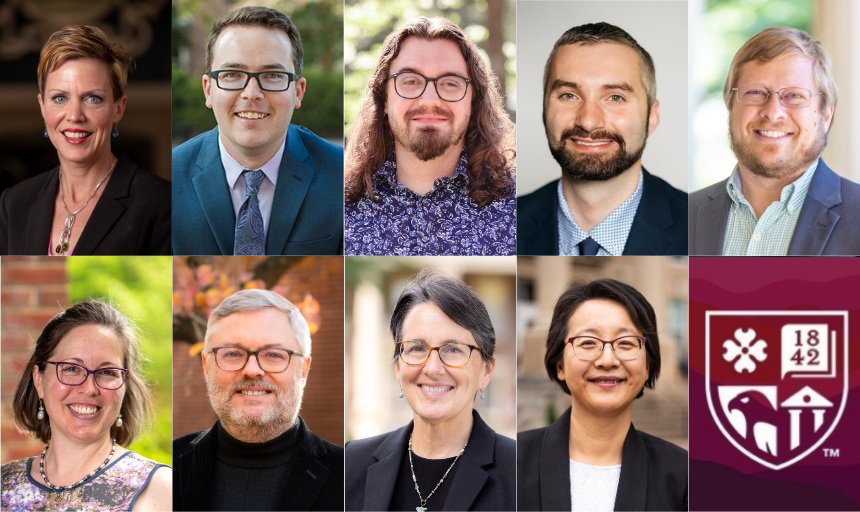
Educators at Roanoke College are using their expertise to expand our understanding of the world. Here’s a look at a few highlights:
Professor and Dean Alice Kassens (School of Business, Economics, and Analytics) co-authored new research for the Federal Reserve Bank of St. Louis, where she holds a fellowship. Her latest paper, “Young Adults and the Softening U.S. Labor Market: A Warning Sign?,” highlights the hiring challenges faced by young adults, particularly those not in school and without a college degree. Kassens also was selected to present at the Southern Economic Association’s annual meeting in November, sharing insights on micro-credentialing in the classroom inspired by work she did with economics students at Roanoke — research that has since been accepted for publication in the Virginia Economic Journal. At the November conference, she served on a panel for early-career economists, offering advice on how to maintain research productivity while balancing teaching and other duties. Additionally, in February, Kassens was invited to Freedom First in downtown Roanoke to present on the current state of the economy and recession risks.
Executive Director for Administration & Chief of Staff Ryan King (Office of the President) has been selected for a Google & GSV Higher Ed Leader Fellowship. This prestigious global program brings together leaders who are reimagining what’s possible in education. Over the next year, King will collaborate with other leading institutions and develop a transformational project that can be introduced at Roanoke.
Lecturer Dalton Meyer (Biology) was invited to share his research with an international audience at the Society of Vertebrate Paleontology’s annual meeting in Birmingham, England. His presentation, “The Anatomy of the Carpus and Tarsus of Squamates Provides Novel Morphologic Support for Key Molecular Clades,” explored how studying the wrist and ankle bones of lizards can help resolve long-standing conflicts in their evolutionary history. Using detailed 3D images of bones, Meyer’s work revealed patterns that help build a clearer picture of how animals evolved over time.
Visiting Assistant Professor Zane Mullins (Economics) published new research in The Economic History Review entitled, “The Circulation and Distribution of Classical Greek Coinage.” His work analyzed over 160,000 coins from ancient Greece (550-300 BC) to track how widely the currency circulated across the Mediterranean and what it reveals about the influence and trade patterns of Greece’s most prominent city-states.
Associate Professor and Assistant Dean Jonathan Snow (School of Education, Government, and Society) has provided timely analysis of events in Iran for international, national and local media, drawing on his three decades of experience studying the region. Snow is an expert in the complex politics and history of the Middle East and head of Roanoke’s Middle East Studies, International Relations, and Political Science programs. He’s been interviewed by The Independent, Fox News and WDBJ7 (CBS/Channel 7).
Professor and Assistant Vice President for Curriculum & Advising Leslie Anne Warden (Art History) was a featured speaker at George Mason University’s symposium on the Mirage of Ancient Egypt. Her presentation, “An Egyptian Imagining of Ancient Egypt,” highlighted insights gained from her decades of experience leading archaeological digs and uncovering artifacts of the daily lives of ancient Egyptians. Warden also recently delivered the Hummel Lecture at Virginia Tech, presenting on the topic entitled, “Ancient Egypt: An economy of bread and beer.”
Associate Professor Robert Willingham (History) was featured on the podcast Tea, Tonic and Toxin, where he discussed the work of novelist Graham Greene. Willingham, an expert in World War II history, shared insights into life during the war and the impact of the Blitz, adding deeper context to Greene’s writings about wartime London.
Vice President for Academic Affairs Kathy Wolfe was tapped to speak on a leadership panel on Humane Leadership in Hard Times: Faculty Governance and Academic Change, for the Council of Independent Colleges’ Institute for Chief Academic Officers. The national event brought together educators from across the country. Wolfe discussed the challenges and opportunities that leaders face as they guide campuses through change while continuing to support faculty and students. She also facilitated a roundtable on collaborating with college presidents, emphasizing strategies for building strong, community-focused leadership in higher education.
John R. Turbyfill Professor Stella Xu (History) was featured in Korean media coverage after leading the establishment of the Kim Kyusik Center for Korean Studies. Created in partnership with the Korean Embassy, the Korean Independence Hall, and the Ministry of Patriots and Veterans, the facility is named after Korean Independence Movement leader and Roanoke alumnus Kim Kyusik. It will support research, cross-cultural partnerships, and global student opportunities. The center’s opening was reported on by Korean media including two articles in the Korea Times and in Naver, as well as local media such as the Salem Times-Register and WFXRTV (FOX/Channel 27).