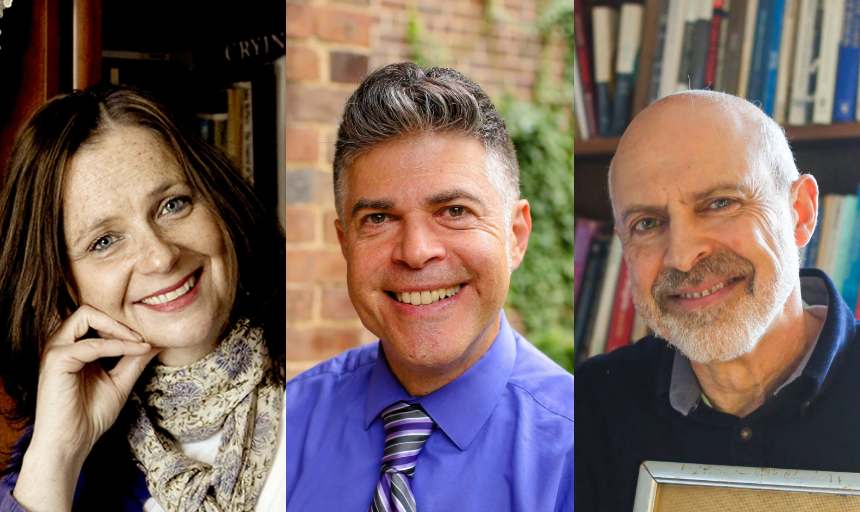
After nearly a century of combined service, three distinguished professors are retiring, leaving a legacy of leadership and mentorship that extends well beyond campus.
“They have taught many hundreds of students, influencing not only those students’ lives but the lives of all who know them,” said Kathy Wolfe, dean of the college and vice president of Academic Affairs.
Roanoke College bestowed emeritus status on the professors and presented them with the prestigious Simon Carson Wells Medal, named for the college’s first faculty member of record. Please join us in celebrating them and their careers spent in tireless pursuit of wisdom, beauty, and understanding.
Melanie Almeder, Professor of Literary Studies and Creative Writing, Emerita
 Almeder, an award-winning poet, inspired students to discover their voice in the power and melody of language. She joined campus in 1999, introducing classes to great works that took them around the world — literally, in the case of her popular May Term course to Ireland, where she guided hikes over the hills of Donegal and joined late-night singalongs in Connemara.
She served as director of the Visiting Writers Program, bringing over 30 internationally acclaimed writers to campus. Her teaching was recognized with the Dean’s Exemplary Teaching Award, an Outstanding Faculty Award from the Virginia State Council of Higher Education, and a nomination for the Carnegie Foundation's U.S. Professors of the Year Award.
Colleagues described Almeder as someone with an inextinguishable enthusiasm for discovery and an openness to the world, which she brought into her teaching, instilling in her students a sense of empathy and curiosity. She was selected as a writer-in-residence for programs in the U.S., Ireland, France, Spain, and Greece.
Her poetry and essays on art have won numerous prizes, including the Yeats Award, Zócalo Prize, and Emily Dickinson Award. Currently, she’s working on her first novel.
Gordon Marsh, Professor of Music Studies, Emeritus
 Marsh has been a defining part of the music program since arriving at Roanoke in 1996, teaching everything from theory and composition to world and popular musics. Known for embracing innovative education models, he helped pioneer the college’s signature Intellectual Inquiry Program and integrated the music curriculum into the campus’s broader liberal arts mission.
His work earned him multiple nominations for the Dean’s Exemplary Teaching Award and music research residencies at the Cite Internationale des Arts and the Centre Pompidou in Paris. He served as chairman of the Fine Arts Department (twice), Director of Pedagogical Development and Director of the General Education Program, to name just a few roles.
A deeply talented composer, he’s written more than 20 original works and performed nationally throughout his career. His fellow faculty members described him as a beloved teacher and friend whose “characteristic energy, humility, understated wit, honesty, and sharp judgment” made him an asset to students and colleagues.
Ned Wisnefske, Professor of Religious Studies, Emeritus
 Wisnefske, a respected scholar who helped shape important conversations on and off campus, was instrumental in establishing the Religion and Philosophy Program when he joined Roanoke in 1985. He later served as department chair, dedicating himself to supporting the program’s students.
Known for his gentle presence and thoughtful counsel, Wisnefske became a trusted source for guidance across campus. Beyond Roanoke, he was a leading voice in the Evangelical Lutheran Church in America, contributing to committees on ELCA positions and identity, always advocating for openness and liberty. He also chaired the candidacy committee for the Virginia Synod of the ELCA, helping new ministers and deacons discern their callings.
Wisnefske is the author of five scholarly monographs and a children’s book, each exploring big questions at the intersection of ethics and theology. On campus, he was regularly the first to arrive in the office and maintained an open-door policy that welcomed students and faculty alike.
"He took care to remember something about everyone he came into contact with,” his peers wrote in a resolution honoring Wisnefske’s service, adding he “never failed to make everyone’s day brighter.”