When Roanoke College officials rolled into 1847 Salem in a wagon and set up in an abandoned church east of town, they could hardly imagine a reliable fountain pen—much less students learning on computer screens and seeking advice from artificial intelligence.
Much has changed in academia—and the world—since then (reliable fountain pens were invented in 1884), but Roanoke’s foundation as a residential liberal arts school remains intact.
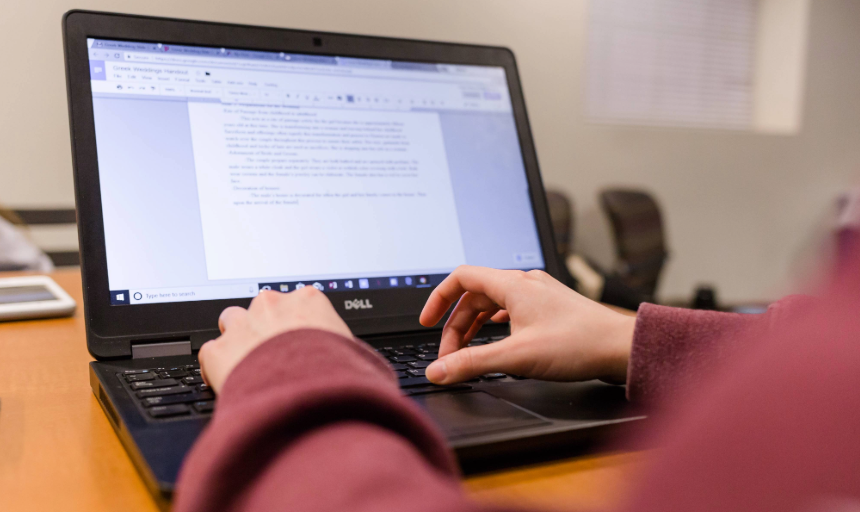
With the strength of that foundation, the college has weighed tradition against transformation in its approach to virtual learning. It has become clear that online technology brings essential flexibility that learners need in the modern era.
For some students, online learning is more than a niche opportunity—it is a necessity.
The changing landscape
According to the National Center for Education Statistics, 61% of American undergraduate students were enrolled in at least one distance education course in fall 2021. Twenty-one percent of all undergrads were enrolled in distance education courses exclusively, and 21% of students at private nonprofit institutions like Roanoke College were taking virtual courses exclusively.
“Even at many residential colleges like Roanoke, most students are taking at least one course online,” said Kathy Wolfe, Vice President of Academic Affairs and Dean of the College. “And I think more students are working to help pay for college, and more learners have children at home. So I think it’s really a matter of flexibility and just being able to fit the learning in when it works for you.”
The benefit of offering virtual classes is two-pronged for Roanoke: Yes, it creates fresh revenue streams at a time when the number of traditional-age college students is in decline. But it also makes continuing education more accessible to the larger community, which can strengthen the local workforce and, ultimately, the entire region.
This speaks to the No. 1 imperative in “Imagine Roanoke,” the college’s strategic plan: “to become the Roanoke Valley’s most sought-after educational partner by industry, entrepreneurs and community leaders.”
“I think it’s exciting to realize how many people will be able to access Roanoke College in a way they could not or would not have thought of doing before.”
Lisa Stoneman, RC-RV
Partnering for progress
RC-RV, Roanoke’s new independent, co-educational initiative, has been driving the effort behind that imperative. Lisa Stoneman, assistant vice president over RC-RV, said RC-RV representatives have met with as many as 40 regional businesses to determine their employees’ continuing education needs and design credit-bearing online courses to address those needs.
“I think it’s exciting to realize how many people will be able to access Roanoke College in a way they could not or would not have thought of doing before,” Stoneman said.
So far, RC-RV has offered certificate courses in cannabis studies, had two rounds of a Certified Pharmacy Technician course, is currently enrolling students for Leadership in the 21st Century and is designing stackable certificate courses in professional communication and entrepreneurship.
RC-RV is also making plans to offer online applied Bachelor of Science degrees in public administration and cannabis studies. These 100% online, asynchronous programs can be finished in as little as 3 years. The public administration degree, which is ideal for public safety officers seeking advancement, stemmed from conversations with Cardinal Criminal Justice Academy in Roanoke.
Additional new programming will soon be developed in RC-RV, which also continues to host Summer Academy camps.
Another new addition to Roanoke College’s online offerings is an online Master of Business Administration (MBA) program that will be flexible and asynchronous, with rolling admissions that allow students to start the program in August or January. For just 15-20 hours per week and $1,850 per course, students can finish Roanoke’s online MBA degree in just 24 months.
Designing for everyone
At least 50 Roanoke College faculty have completed online pedagogy training, learning the many differences between designing and teaching an in-person course versus a virtual course. A few, like Spanish Lecturer Christine Stanley, already had extensive experience teaching virtual classes.
To be a successful virtual teacher, Stanley said, a faculty member must be highly organized, maintain excellent communication, plan active engagement with students and offer continuous feedback. This is easier to achieve at a school like Roanoke, where online class sizes will remain small, than at schools offering massive online classes to hundreds of students at a time.
As more online courses are designed, Wolfe said, the college will continue to prioritize those one-on-one faculty-student interactions and engaging lesson plans that make Roanoke stand out as a small school with big spirit.
“You have to be so much more intentionally available to online students to keep them engaged and help them feel like they have support,” she said. “We will always be thinking about how we can do it better.”
To learn more about online programs at Roanoke College, visit roanoke.edu/online-programs.